

Music: Taste As Compass
How taste became an act of rebellion in today’s homogenous music landscape

This is the final article in a three-part series titled “Understanding Taste”, a new study written by SQR EYE Studio and Say Less for DotDotDot in collaboration with Kemmler Kemmler.
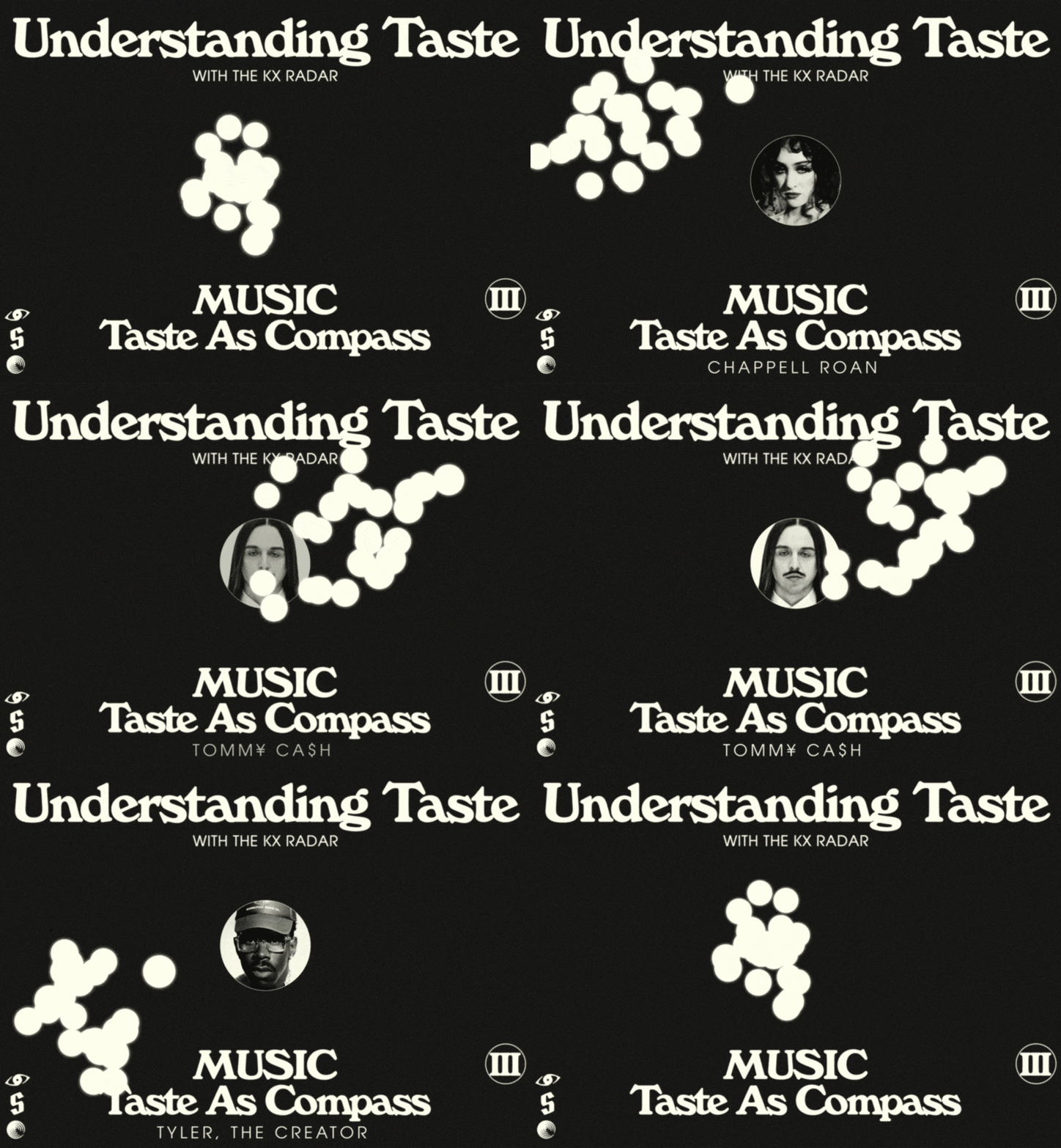
In days gone by, music was something to build your entire identity around. What you listened to dictated who you hung out with, how you dressed, where you loitered and even the kind of virtues you upheld, on your own or part of the collective.
Emos, mods, rockers, punks, hip hop heads. They still exist, but largely as fleeting trend-du-jours; aesthetic codes that are mined for a shot at getting ahead of the next feed-flooding ‘core.’
Amongst this sea of sameness, there are mavericks with distinct taste. Some of them use the “sameness” of our musical landscape as a way to be familiar yet surprising. Some subvert by using “bad taste” as a breakthrough. And some are in a constant “create and destroy” cycle so that the word “same” never shows up on their Pitchfork album reviews.
“Taste is something money can’t buy. It’s about identity. Do I know who I am? Do I know what I enjoy? We need to be very careful in judging what good and bad taste is,” Jonas Weber, CEO of ColorsxStudio tells us.
Taste is an important form of self-knowledge. That’s why it still matters.
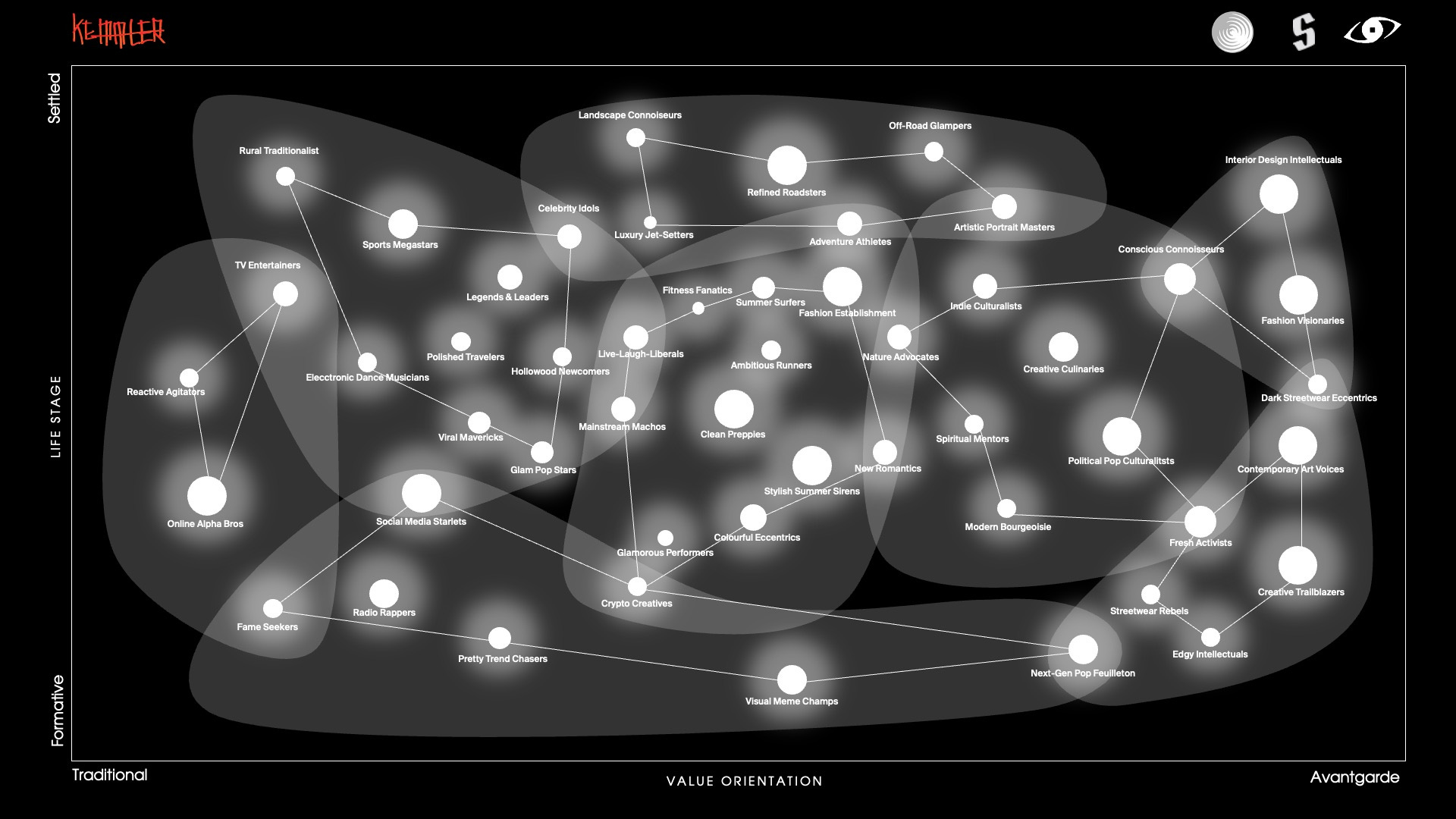
In the final piece for our three-part ‘Understanding Taste’ study, we’ve analyzed the audiences of taste mavericks Chappell Roan, TOMM¥ CA$H and Tyler, The Creator on the KX Radar in a bid to understand today’s taste landscape and how the best are navigating it.
Chappel Roan: Familiar Yet Surprising
Chappell Roan’s craft takes her into many different taste communities on the KX Radar. Her audience clusters around queer, fashion-savvy, and politically vocal communities. The fascinating thing about Roan’s music is that it strikes the balance between feeling familiar and enigmatic. She occupies a world that’s vaudevillian, expressive, infinitely quotable—perfectly optimized for modern attention economy.
As NTS DJ and producer Peach puts it, “Working in music, your taste is everything. You’re constantly trying to showcase it, while also trying to refine, grow and develop it.”
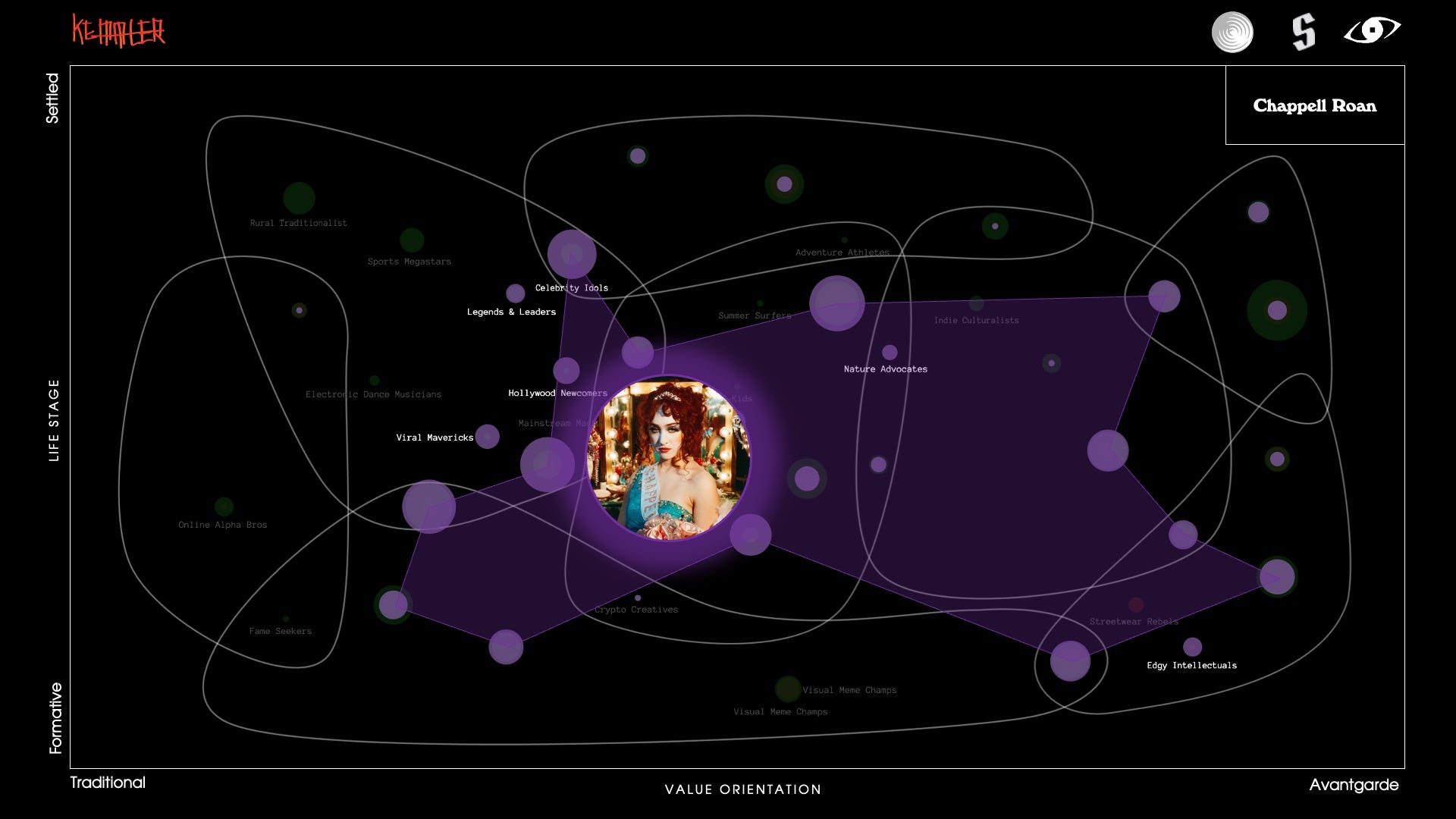
Roan understands this. Her work adopts codes, remixes conventions, and offers nostalgia threaded through zeitgeist. It’s less about breaking musical form and more about knowing exactly which forms to bend and how to repackage what already exists.
Roan isn’t random or superfluous for the sake of it. She plays credibly into drag culture and the intricate sensibilities that make it up. She then uses her catchy music as a gateway to pull new people into these more complex worlds.
This kind of approach keeps things fresh but consistent, and to do so must be underwritten by a firmly established sense of taste. Something built upon an appreciation of contemporary convention, and the cultural tradition you’re looking to work within.
TOMM¥ CA$H: When Bad Taste Wins
There’s a strange side effect of algorithmic culture: at scale, irony is indistinguishable from appreciation. Content spreads whether people love it or hate it—so long as they share it.
Being horribly bad at something can be as virally valuable as being good.
Estonian maverick, musician, and serial high fashion muse TOMM¥ CA$H understands this intimately. He creates confusion. While others merely adopted irony, he was born in it. It’s identity-motivated misdirection.
Weber notes, “We shouldn’t look for formulas. What works for someone like TOMM¥ is that it’s authentic. If you really know who you are and what you stand for, that’s worth more than following a recipe.”
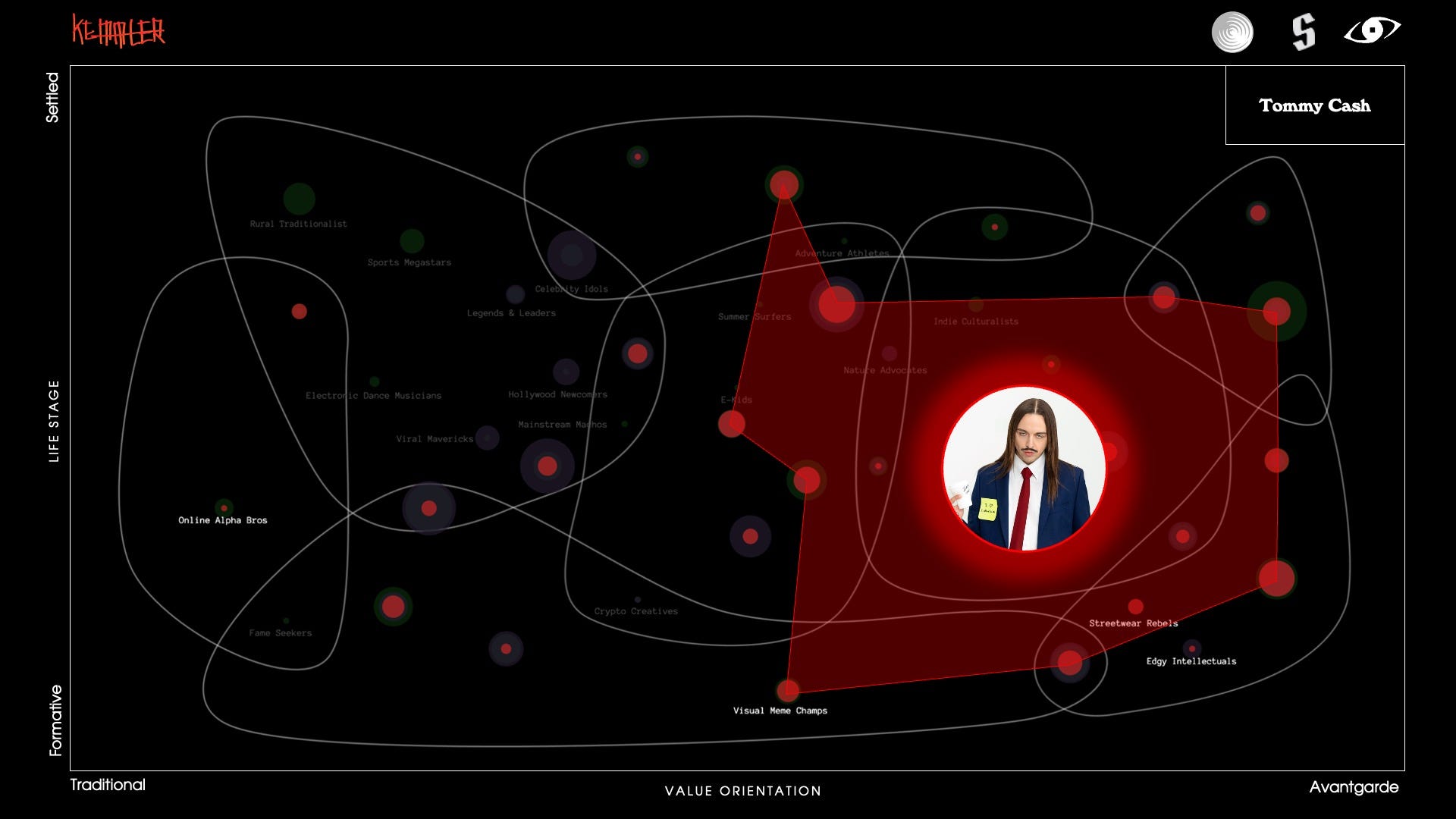
Looking at the KX Radar results, CA$H knows that he speaks with avant garde online communities that are already fluent in irony, memes and cultural trolling. These younger, progressive audiences are also more open to critical perspectives on social and systemic norms within music, which is exactly the terrain CA$H plays in when he leans into the grotesque, the kitsch and the “too much” as raw material.
The irony bit can get you to the top, but it’s not as simple as being as bad as possible for the sake of it. It’s about appreciating a certain audience perspective and then constantly yanking it into interesting directions. One used to catch CA$H front row at Rick Owens, Vetements or Diesel in some wild costume, which became expected. Then in 2025, we saw him take to, Eurovi*ion singing a song about Espresso in a mock Italian accent to a global audience of people who barely knew better. Misdirection a’la CA$H.
He never lets us know his next move. He’s a Rick Roll wearing Rick Owens — ready to clog your feed at any moment. CA$H is a genius at content gamesmanship (turning the bad into the unmissable)— where taste can be found in a pair of bread loafers.
Tyler, The Creator: Create & Destroy
Looking at Tyler’s KX Radar results, you can see the effects of his full character reboot for each album scattered across the map. Goblin, Wolf, Cherry Bomb, Flower Boy, Igor, Call Me If You Get Lost, Chromakopia, Don’t Tap The Glass: every era arrives with its own color palette, typography, silhouettes, video language and emotional register. This rallies existing taste communities and creates new ones simultaneously.
Yet all of this feels unmistakably him. As Weber explains: “You shouldn’t try to reinvent yourself every record for the sake of it. There has to be a connective tissue — and often that’s taste, an artist’s intent expressed through different iterations.”
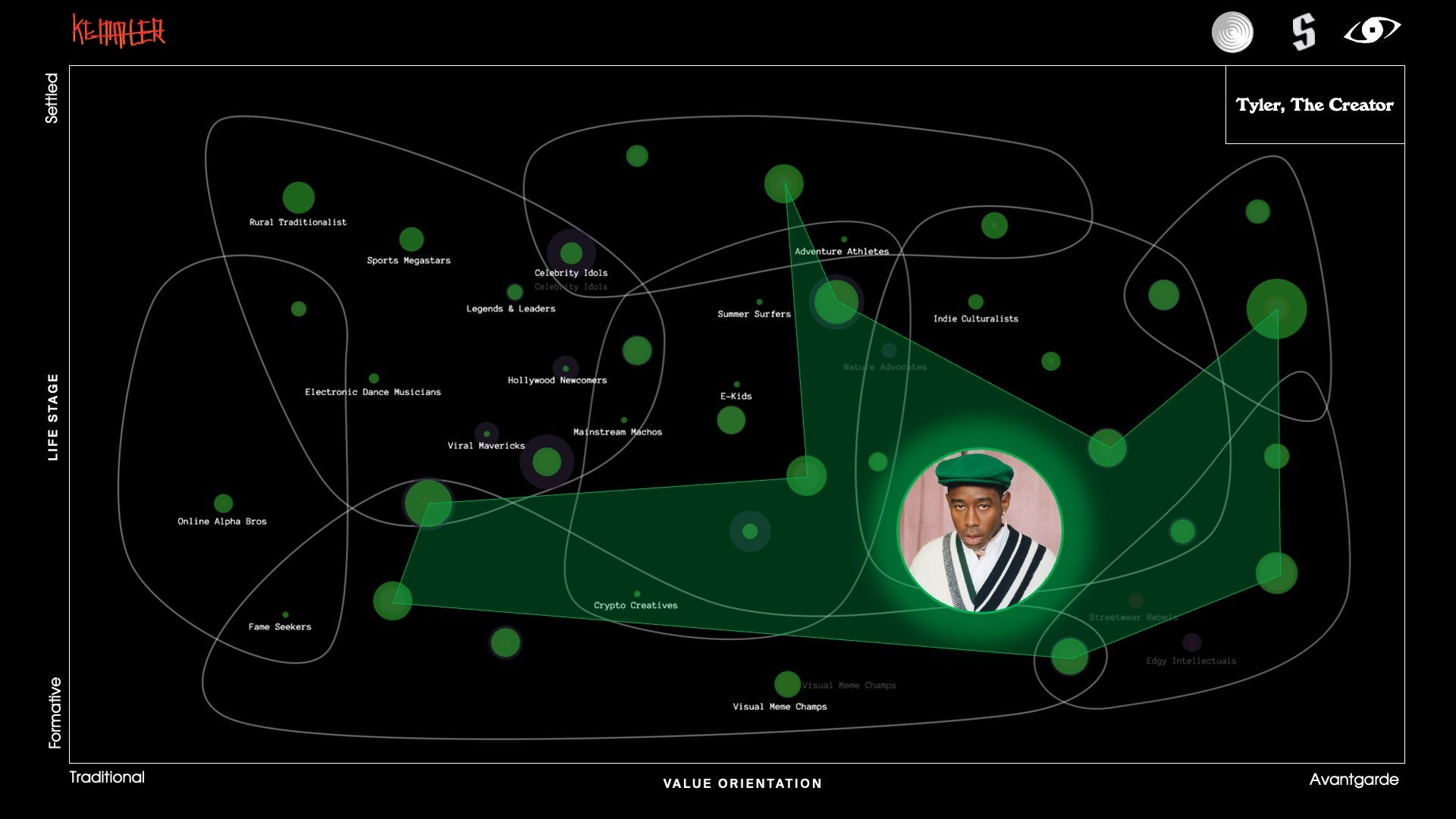
Tyler’s connective tissue is his taste: a self-authored operating system he updates, destroys and rebuilds with each project. Each cycle pulls in a slightly different cluster of people: skate kids and Odd Future diehards in one moment, soft-focus internet romantics the next, then luxury-curious preppies, then filmmakers and architecture students.
His steadfast confidence in his own taste, and the trust that his millions of fans have in him give him the permission to explore all of these fields that play into the wider Tyler brand. It keeps his audience engaged well beyond the traditional album and touring cycle, and makes him an invaluable asset to cultural progress.
Tyler, The Creator is a master of curation. He never gets caught in an era. As other artists catch up to his sounds, he’s already busy creating the next thing. Letting go to stay ahead is the drum that he bangs.
How To Work With The Taste Mavericks
So what does this all mean? Well, these taste mavericks aren’t your typical artists. For brands wishing to partner with them, the classic this x that sponsorship won’t cut it. Weber challenges us to ask: “Is it additive or is it exploitative?”
Here’s how to effectively work with the taste mavericks:
Give them something new to play with: Vans gave SZA an artistic directorship. Converse are bringing back Rubber Tracks, a fabled program in service of access, resource and skill sharing for emerging artists, which doesn’t rely on star power at all. Give the artist tools that they can work with to make something that challenges, excites and appeals within the framework of what they like and what sounds or looks fresh to them.
Don’t follow the audience, follow the artist: Rick Rubin’s Creative Act works against every marketer’s intuition. True artists don’t create for an audience, they create for themselves. As a brand, you must work with artists to free yourself from the confines of your community by curating things outside of your immediate orbit.
If you stay within the algorithmic whitewash, you’ll just move with the trend tides — wash in, wash out — forgotten. Paddle out and catch a big one. Maybe you get dumped, maybe it’s the best ride of your life but either way you’ll be remembered for it.Trust the people they trust, and don’t be afraid to relinquish control: If you’re working with an artist, allow them to bring their creative partners along. Just look at PG Lang from Kendrick Lamar — not only is he building his own creative universe, he’s building it for others now through a new creative collective turned agency Project 3.
Artists are often surrounded by the best of the best. When you work with them, they need to feel like their vision is being multiplied, and their close collaborators often hold the keys. Don’t force the process on top of them, trust it.
In the end, taste shouldn’t be an algorithmic formula but a navigational system. Crucially, it’s how artists, audiences and brands learn to move through a landscape where everything looks the same on the surface yet lands very differently in the gut. The acts that cut through are the ones willing to curate with intent, weaponise their weirdness and treat bad taste, nostalgia and novelty as materials rather than masters.
Taste is the only real instrument left that can still change the tune.